Exodus 12:15
For seven days you are to eat bread made without yeast. (NIV)
Today’s Reading: Exodus 12:12-20 and 1 Corinthians 5:1-13
God is establishing the Feast (or Festival) of Unleavened Bread in this passage. We will get much more detail about this week in Leviticus. This would be the first of two week-long festivals that God commands the Israelites to observe with the other being the Feast of the Tabernacles. God would eventually establish a total of seven feasts for his people to observe – four in the spring and three in the fall. Thus the Feast of Unleavened Bread is the second of the seven feasts. The first feast is the Passover.
For seven days they were to eat bread made without yeast. The symbology of the seven days isn’t crystal clear to me. The number seven has so much significance in Scripture. The number seven is a symbol of perfection, completeness, and holiness. It could be as simple as pointing to the perfection of Jesus.
The seven days could also be pointing to us. The Israelites were to remove all the yeast from their house on the first day and keep the yeast out for all seven days. If anyone at anything with yeast in it during those seven days, they were to be cut off from the Israelite community. This has a parallel to the words of Paul in his first letter to the church in Corinth.
“Your boasting is not good. Don’t you know that a little yeast leavens the whole batch of dough? Get rid of the old yeast, so that you may be a new unleavened batch—as you really are. For Christ, our Passover lamb, has been sacrificed. Therefore let us keep the Festival, not with the old bread leavened with malice and wickedness, but with the unleavened bread of sincerity and truth” (1 Cor 6-8).
The “Festival” that Paul is referencing in this passage is the Festival of Unleavened Bread. But he’s changing the way this festival is to be observed. We are to observe the festival everyday by removing the levin from our lives. In other words, leaving our life of sin as Jesus instructed the woman caught in adultery (John 8:11).
Paul is not talking about how we are saved. We can’t save ourselves by sinning less. He is talking about the walk of the believer after we have been saved. The Greek word for sincerity here is better translated as “pure motives.” Pure motives never saved anyone. But if you are a child of God, you will be sincere. Once we accept Christ, we are to seek God’s kingdom with pure motives and in truth.
So if this is the parallel to the seven days of eating nothing with yeast, then God could simply be telling us that this isn’t a one day event. Ridding the sin from our lives is going to take some time. It will likely take a lifetime! Thankfully we are saved by the blood of Jesus. Our response is simply to live like him.
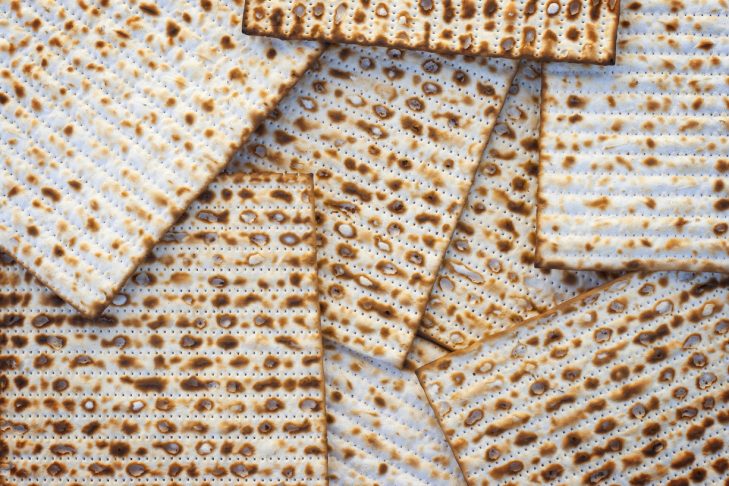
But let’s look at this unleavened bread. The Hebrew word for unleavened bread is matzah. Matzah can be either soft like a pita or crispy. If you purchase matzah from the grocery store you will purchase the crispy matzah since the soft matzah has a short shelf life. Here’s a picture of crispy matzah:
Jesus tells us that he is the bread of life in John 6:35. We also know that yeast is symbolic for sin. So this unleavened bread represents Jesus who was without sin. Jesus tells us in that same passage, “I am the living bread that came down from heaven. Whoever eats this bread will live forever” (John 6:51). Jesus is making the symbology pretty clear for us that he is the matzah.
Take a closer look at the picture above of matzah. Matzah has stripes burned into it due to the baking process and it must be pierced with holes to prevent it from rising. Jesus was flogged prior to his crucifixion which would have left stripes all over his body. And after Jesus died on the cross, one of the soldiers pierced his side to make sure he was dead. Just like the matzah, Jesus was pierced and striped.
During the Last Supper with his disciples, “Jesus took bread, and when he had given thanks, he broke it and gave it to his disciples, saying, ‘Take and eat; this is my body’” (Matt 26:26). Jesus makes it crystal clear that he is the matzah. He is the Passover Lamb and he is the Bread of Life.


Leave a Reply