Exodus 26:14
Make for the tent a covering of ram skins dyed red, and over that a covering of the other durable leather. (NIV)
Today’s Reading: Exodus 26:1-14 and Isaiah 53
God gives Moses specific instructions of how to make the outer curtains of the tabernacle. We have four sets of coverings made of fine linen, goat hair, ram skin and durable leather.
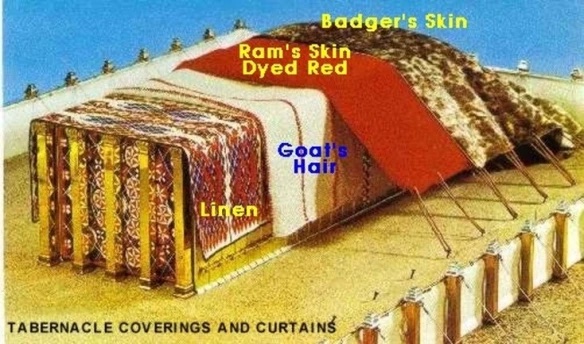
We are trying to find Jesus in the details of the tabernacle so let’s dig in. The first covering was made of fine linen of blue, purple and scarlet with cherubim woven into them. There were to be ten curtains that were 28 by 4 cubits woven together in two sets of five. Then those two sets of five would be joined together by fifty gold clasps through the loops at each end of the two sets.
Here’s some potential meanings and reminders from God to all of that detail:
- The number 5 symbolizes God’s grace, goodness and favor toward humans. Ten symbolizes complete and perfect. So the ten curtains in two sets of five are reminders that God’s grace is perfect. This union of curtains also symbolizes that we will be united to God through Jesus. “But whoever is united with the Lord is one with him in spirit” (1 Cor 6:17).
- The number 50 symbolizes deliverance from a burden. God commanded to the Israelites in Leviticus 25 that every fiftieth year, on the Day of Atonement, that a Jubilee was to be declared. During the Jubilee year, all debts were settled in favor of the debtor and inheritances were returned to their rightful owners. Also, those who worked as slave laborers in order to repay a debt were granted their freedom to return home to their families and land.
- Blue represents God or something dedicated to a holy purpose. When Moses and the elders saw God in Exodus 24, they saw blue. “Under his feet was something like a pavement made of lapis lazuli, as bright blue as the sky” (Ex 24:10).
- Purple can represent royalty and majesty as well as conveying the meaning of wealth, prosperity and luxury. The rarity of purple in nature and the expense of creating its dye gave it a great deal of prestige.
- Red symbolically represents sin and sinfulness. We know that God requires the shedding of blood for the forgiveness of sins.
So putting the elements of the first covering together through the lens of Jesus, we see that Jesus would be deity (God), holy and royalty. He would spill his blood to bring unity to God and his people and release us from the burden of sin. Our debt would be settled.
The second curtain would be made of goat hair. This time there would be eleven curtains that were 30 by 4 cubits woven together in two sets of five and six woven together by fifty gold clasps through the loops at each end.
- The number 11 often represents state of disorder, incompleteness or transition. The number 12 represents completeness such as in the tribes of Israel or the apostles of Jesus. One short of that number makes it incomplete. So the number 11 serves as a reminder of the need for repentance, divine intervention, and the ultimate restoration of God’s perfect order.
- We’ve discussed many times before that the number 6 is related to man and human weakness. God created man on the 6th day and is one short of the perfect number 7.
This covering seems to point to God’s grace being extended to humanity through Jesus. We are in need of divine intervention and God would provide that in the sacrifice of Jesus as we see also in the priestly requirements on the Day of Atonement. Two goats would be offered up – one as a sacrifice and one as a scapegoat. The sacrifice would restore our relationship with God and the scapegoat would carry our sins into the wilderness.
We aren’t given any details by God of the last two coverings. One would be made of ram skins dyed red and the other would be made of durable leather. The red covering would again remind us of the sacrifice of Jesus and his blood that would be shed for us. The durable leather covering is somewhat a mystery. It could be to point us to the ordinary appearance of Jesus. Under the leather covering were three other coverings that held great symbolism and were increasingly more expensive material. The ordinary durable leather would be all we would see. It reminds me of Isaiah 53:2-3:
“He had no beauty or majesty to attract us to him,
nothing in his appearance that we should desire him.
He was despised and rejected by mankind,
a man of suffering, and familiar with pain.
Like one from whom people hide their faces
he was despised, and we held him in low esteem.”
 Christ in the Old Testament
Leave a comment